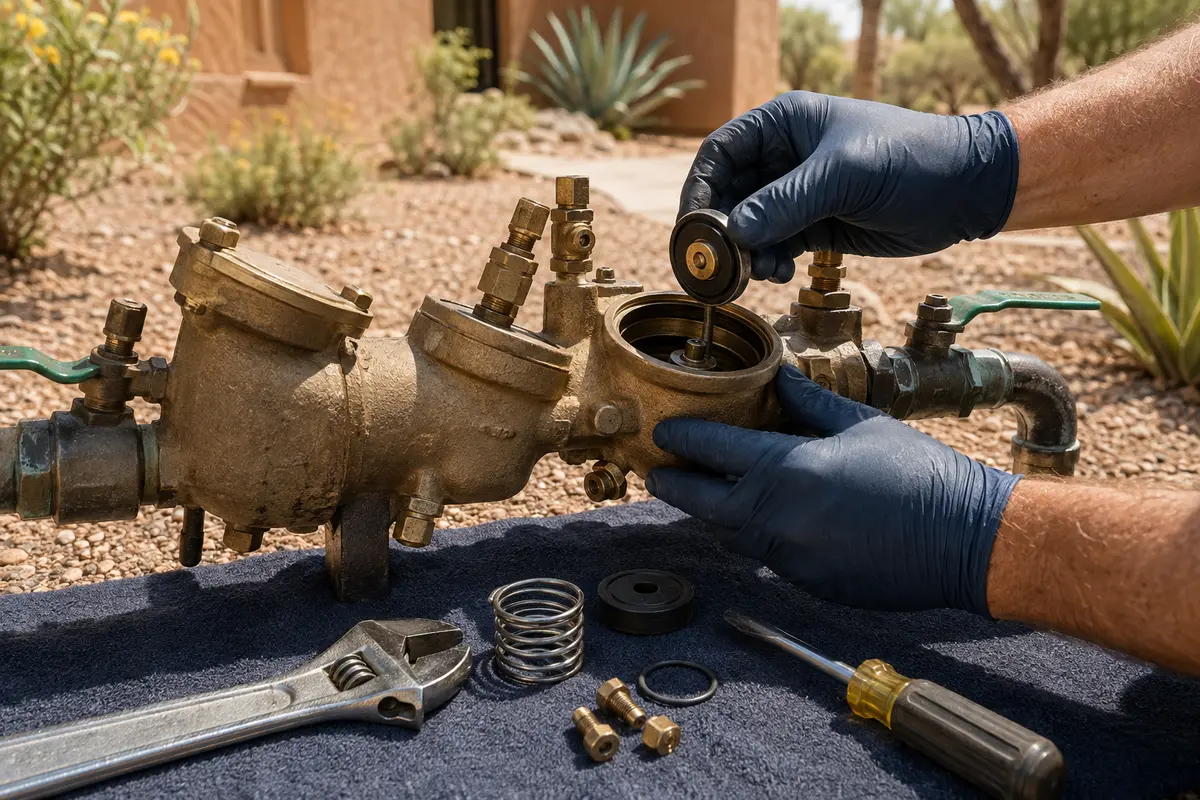
Did your backflow assembly fail a test, leak, discharge water, or stop operating as expected? This Northwest Tucson resource provides information about practical backflow repair support for residential, irrigation, and commercial systems across Marana, Oro Valley, Catalina, Northwest Tucson, and nearby Pima County communities.
Review backflow repair considerations
Backflow Repair After a Failed Test or Equipment Problem
A failed backflow test means one or more components did not meet the required test criteria at that time. It does not automatically mean the complete assembly must be replaced. Many devices can be returned to service by cleaning internal components, replacing worn parts, correcting a valve problem, and completing a successful retest.
The right repair depends on the assembly type, size, manufacturer, condition, accessibility, parts availability, and the specific test result. The process begins by reviewing the available information, explain the likely scope, and confirm additional work before proceeding.
Common Backflow Assembly Problems
- Check valves that do not seal or hold the required pressure
- A relief valve that opens too early, does not open properly, or continues to discharge
- Worn seals, springs, rubber components, or internal check modules
- Debris, mineral buildup, corrosion, or damage inside the assembly
- Shutoff valves that leak, bind, or cannot be operated safely
- External leaks around covers, test cocks, fittings, or valve bodies
- Freeze, impact, weather, or landscaping damage
Visible water does not always identify the internal cause, and different assembly designs fail in different ways. Testing and inspection help narrow the problem before parts are ordered or the device is disassembled.
Assemblies and Properties Covered
Repair needs can arise on a home’s service-protection device, an irrigation backflow assembly, or a larger commercial installation. This resource covers property information for:
- Residential backflow prevention assemblies
- Irrigation and landscape connections
- Commercial and multifamily properties
- HOAs, managed communities, retail, and office sites
- Properties with several domestic, irrigation, or specialty devices
Include the assembly manufacturer, model, size, serial number, and photos when possible. A prior test report is especially useful because it shows which component failed and the measurements recorded during testing.
Understanding the Backflow Repair Process
- Review the failed result or reported problem. The property owner should confirm the property, device information, symptoms, and applicable deadline.
- Inspect the assembly and access. A qualified provider should evaluate visible condition, configuration, shutoff operation, and factors that could affect safe service.
- Confirm the repair plan. A qualified provider should explain the likely work, parts needs, and whether repair remains practical.
- Complete approved repair work. Internal components are cleaned, adjusted, rebuilt, or replaced as appropriate for the assembly.
- Retest the device. Testing confirms whether the repaired assembly now meets the applicable criteria.
- Document the outcome. The responsible tester or provider should prepare or submit the result through the relevant utility process when that service is required.
Repair or Replacement?
Repair is often the preferred first step when the assembly body is sound, the device is accessible, and appropriate parts are available. It can preserve an existing installation while addressing the specific component that failed.
Backflow replacement may be the better long-term choice when the device is heavily corroded, repeatedly fails, has damaged castings or shutoff valves, is obsolete, lacks available repair parts, is incorrectly sized or configured, or would cost nearly as much to rebuild as to replace.
A careful evaluation should not treat every failed test as a replacement. A qualified provider should explain the practical options so the property owner or manager can make an informed decision. Installation, retrofit, and replacement may also involve permits or utility requirements that do not apply to a routine internal repair.
Retesting and Compliance Documentation
When an applicable assembly fails, repair alone does not establish a passing result. The device must be retested after the work to confirm that its components perform correctly. The passing retest and repair information can then be recorded for the property and submitted according to the water provider’s process.
Reporting requirements vary by utility. Marana Water and Oro Valley Water Utility operate their own backflow programs, and local deadlines, tester registration, certification, permit, and submission rules may differ. See the local guidance for Marana and Oro Valley, or include the utility notice for provider review.
Before the Repair Appointment
Make the assembly accessible and Tell the provider about locked gates, enclosures, tenants, pets, site contacts, irrigation schedules, restricted work hours, or business operations. Water may need to be shut off while the assembly is serviced and retested.
If the device is actively leaking or discharging, send clear photos and describe when the problem began. Do not disassemble a backflow assembly or force a damaged valve. If water is causing immediate property damage, use the appropriate property shutoff procedure and contact the water provider or an emergency plumbing professional when necessary.
Backflow Repair Questions
Can every failed backflow assembly be repaired?
No. Many failures can be repaired, but severe corrosion, body damage, obsolete equipment, unavailable parts, or repeated failures can make replacement the safer or more economical option.
Does the assembly need to be tested again after repair?
Yes. Retesting confirms whether the repair restored the assembly to the required performance criteria. The repair itself is not a substitute for a passing test result.
What information should I send with the request?
Send the service address, water provider, failed test report, due date, assembly make, model, size, serial number, and photos. Include access instructions and any current leak or discharge symptoms.
How quickly can a repair be completed?
Timing depends on access, diagnosis, assembly condition, parts availability, scheduling, and whether additional approvals are needed. A qualified provider should confirm the scope and availability after reviewing the request.
Can you coordinate repairs for several properties?
Yes. Property managers and associations can provide an inventory, prior reports, site contacts, and access windows so the work can be organized by device and location.
Review Backflow Repair Considerations
Send the failed test report or describe the equipment problem, and include photos when available. A qualified provider should review the details and confirm the appropriate next step.